Friday, July 19, 2013

Mindset

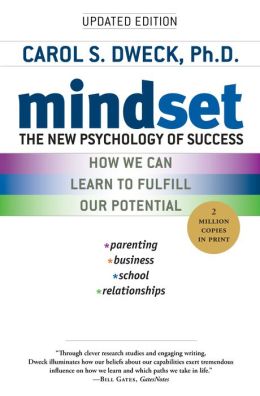
The latest book in my summer reading list is Mindset – the New Psychology of Success by Carol S. Dweck, Ph.D. Ballantine Books ISBN – 978-0-345-47232-8
 

Mindset: The New Psychology of Success

I am just about halfway through the book, but am finding it to be amazing. Dr. Dweck outlines two different mindsets which people hold, beliefs really, and the remarkable differences between how these people approach life. What’s more, she asserts that one can choose a mindset which can aid achievement and development of one’s life.


The contrasts between a “fixed mindset” and a “growth mindset” are rather simple, but very profound and powerful. As we nurture the lives of coaches and competitors, we have opportunities to either feed their fixed mindsets and thereby perpetuate their protection of mediocrity, or we can feed a growth mindset and thereby encourage their work ethic, their productive habits and help them achieve more than previously assumed.


After reading the first chapter, I sent a text message about the book to my friend, Coach Joe Ehrmann. Joe was quick to affirm the value of the book and its message to those who seek to achieve highly in the world of sport.

Friday, July 12, 2013

Free to Compete - Reflections on Sport from a Christian Perspective

This week I sent the manuscript for a new book titled, Free to Compete – Reflections on Sport from a Christian Perspective, to my publisher, Cross Training Publishing. I am excited about this project and I hope it is of value to you and to others who serve men and women of sport around the globe. (ISBN: 978-1-938254-15-4 paperback 176 pages)

This is an excerpt from the Introduction:
“In these weekly emails, now numbering over two hundred fifty, I have sought to take a Biblical and objective approach to sport, to sports culture, to ministry in sport, and to ministry with the men and women of sport. Some of it reads like social commentary as I write about the culture of sport. Some of it reads like analysis as I make observations about trends in sports ministry around the world. Some of it reads like instruction as I reflect upon the most important values in serving the people of sport. “
“I aim to write with as broad a perspective as I am able. I am conscious of my audience’s global nature, but confess that I am quite limited by my central USA background and limited travel. I always seek to reflect the Lord Jesus’ view of sport and the people who live, work, and experience life in it.”

Free to Compete will soon be available directly from Cross Training Publishing (308) 293-3891 (www.crosstrainingpublishing.com) in paperback and via Kindle ebook. (FCA staff may buy at a 40% discount and pay via org transfer.) It will also be available through FCA Gear and retailers like Barnes and Noble and Amazon as well.

Comments on Free to Compete
“Roger Lipe has a unique ability to comment on sport with
a Christian frame of reference. He takes Christ seriously and takes
sport seriously, helping the readers to process their sports experience
in the light of the Bible.”
J Stuart Weir
Executive Director - Verite Sport (United Kingdom)

“Roger Lipe has an exceptional gift for navigating the issues
commonly found in the world of sport and skillfully connecting them
to the truth of scripture in a clear, compelling way. His decades of
experience as a minister to athletes and coaches has provided him
with the wisdom to speak with authority into a sports culture that
desperately needs the truth found in God’s unchanging word.”
Jeff Martin
Exec. Vice President of Ministry Programs and Resources
Fellowship of Christian Athletes (USA)

“Aussie athletes and chaplains love Roger’s approach to personal
development in sport! He nails it culturally when it comes to
God’s Word speaking to the heart of real issues in Sports on identity,
character and life. He’s a kind of Muhammad Ali of sports writers.
Graceful as a butterfly, stings like a… His bold, honest and gracefilled
reflections help sharpen anyone’s pursuit of excellence in faith
and sport – drawing them closer to Jesus.”
Cameron Butler - National Director
Sports Chaplaincy Australia

Section I-Reflections on Life in Sport -
You are Free! 11
Sports Liars 13
“O Lord, Help Us Win Today.” 17
Fear of Failure 21
Integrated or Compartmentalized? 23
Notes on Team Travel 25
The Field of Competition is Holy Ground 27
Reality Check 33
For Whom Are You Playing? 35
Resignation 39
Developing Emerging Sports Leaders 41
What is the Measure of a Coach? 43
High Profile / High Peril 47
Lessons From Tragedy 49
Taming the Tongue 51
Hyper-Average 55
True Identity 57
Which Culture is Holier? 61
Amateurism vs. Professionalism 65
Jesus as Good Luck Charm 67
“I got fired yesterday.” 69
What the Heart Loves, the Will Chooses & the Mind Justifies
Introduction 71
Performance Enhancing Drugs 73
The Win At All Costs Ethic in Sport 77
Racism in Sport 81
Abuse of Players 85
How Faith Becomes Divisive in a Sport Team 89
Integrity Related to Coaches’ and Competitors’ Contracts 93

Section II-Reflections on Ministry in Sport-
A Biblical View of Participation in Sport 99
Highly Committed, But Irreligious 105
The Sport Chaplains’ Dirty Little Secret 107
Don’t Act Like a Fan 109
Through What Lens Do You View Sport? 111
Ministry To or Through Sportspeople? 113
Prominent or Obscure 117
Loyalty 119
Intuition 121
Time Management 123
Extravagant Love vs. Benign Tolerance 125
Mentoring People in Sport 127
What Can We Learn From a Tattoo? 131
Coaching Staff Transitions 133
Game Day Devotions 135
Economy of Opportunity 137
Sports Ministry and Celebrity Culture 139
The Richest Man I Know 141
The Significance of Sport Chaplains & Character Coaches 145
Service vs. Superiority 147
Sport as Worship 149
Celebrity vs. Obscurity 153
Guidelines for Interaction with Coaches & Competitors 155
Misapplication of Scripture in Sports Ministry 157
Sport Culture-Live in It 161
Present vs. Prominent 163
Foolish Comparisons 165
Dynamic Ministry 167
Dan Callahan vs. Cancer 169

More comments:
“Roger Lipe is an excellent communicator. He shares a heart of
compassion and truth in such a way that you will be drawn to learn
more about the Savior he serves and the Kingdom goals he inspires.
Each article is worth the time to not only read for yourself, but to
share with others!”
Bill Houston
Director, Chaplains Roundtable Ministry & Co-Host of Sports Spectrum Radio
Grand Rapids, Michigan (USA)

“Roger Lipe’s vast experience in sports ministry and his passion for
mentoring others makes this compilation of articles invaluable to
men and women serving Christ in the world of sport. Each entry will
cause you to rethink and reevaluate your daily walk with Jesus and
how you minister to others. Don’t miss this opportunity to learn from
a seasoned leader in sports ministry!”
Stephanie Zonars
Team Building Coach (USA)

"To regularly sit in a place of worship centered on the teachings of
Christ will produce a quiet self-confidence to handle any and all pressures
of life, whether as an athlete or in any other of life’s walks.”
Carl Erskine

Brooklyn and Los Angeles Dodgers 1948–1959 (USA)
Friday, July 5, 2013

One more on Sunday Sport

Below is the third and final installment of thought from our friends in the United Kingdom, Christians in Sport, about Sunday Sport. (http://www.christiansinsport.org.uk) Thanks for your giving it a read and for the number of you who responded to the last couple of weeks. My aim here is to spur us to think about this issue, rather than just dismissing the issue to accommodate our assumptions.

 Sunday Sport

Finding practical solutions for the weekly tension between Sunday sport and Sunday church services

16/06/13
There’s no doubt that the tension between Sunday sport and Sunday church services is a significant problem for the church in the UK (as well as the US). Broadly speaking there are two types of approach and both have pitfalls.

First, some churches feel that if they move church to accommodate sport then it sends all the wrong messages about what is most important. Consequently many churches hold to the status quo and may try and make some small provision (youth group on a Friday evening) but generally offer a straight choice between the two.

Secondly, other churches feel that they should be helping their young people engage with culture not disengage, and so they offer alternative service times (e.g. Sunday afternoon) so that parents and their children do not have to choose. However, this requires a church with significant enough resources to be able to do this (no small thing) and it does risk turning Sunday from a church day to a rather hectic schedule where family time is a rare commodity.

How do we decide what to do? Well we need to be clear on the biblical principles at stake here.

1.  A key consideration is to remember what church is for. Church is for building up the body of Christ to attain maturity (Eph 4:12-13), but this maturity must be demonstrated publicly so that the church is ‘the light of the world’ shining its light before others to lead to glory to God (Mt 5:14-16). Straight away there is a tension here then. On one hand of course church will involve some time away from the ‘front-line’, where there is teaching and equipping, but it is always done so that God’s people can get back on the front-line - in their sport, job, among their friends etc. to witness about Christ. The church must see the importance of equipping its people to live in the world and therefore sending them into the world of sport to live for Christ.

2.  A second consideration is that whilst sport is a vital part of God’s good creation, we do need to recognise that the bible is clear that ‘physical training is of some value but godliness has value in every way, both for the present life and the life to come’ (1 Tim 4:8). Please hear me as a passionate sports player, this is not undermining the importance of sport, but it is elevating the importance of spiritual growth. It is therefore worth asking whether as players ‘devoted’ to our sport, or parents devoted to our child’s sport, we show as much commitment to godliness? The stark reality is that long after my sporting ability has faded my character will endure. I sense this is almost a bigger problem for parents who with admirable commitment pour hours into their children’s sport, but as one youth worker put it to me recently “if only I saw as much passion for their children’s spiritual growth!”

A solution then will require balance and appropriate involvement from all sides - pastors, parents, youth workers and the young people themselves. Certain pitfalls will need to be avoided:

-  The pastor or youth worker who has a ‘quiet word’ with the parents, telling them to get Sara to give up her county swimming because its taking her away from church. Have they thought about the disenfranchisement that she could feel with church as a result, and even if she doesn’t what about the subtle message she is learning that church = cultural disengagement?

-  The parents who admirably try to fit Ankur’s church around sport, but without thinking about how they can marry the two together or communicating adequately to their church. Consequently he picks up the significant signal that church comes second to sport (particularly when they win!) and quickly it becomes very difficult for him to have meaningful contact with church and other Christians his age.

There are no easy answers and no one ‘out of a box’ solution that every parent and youth worker can implement, but considering the above principles here are some suggestions to help think this difficult area through.

1.  Communicate. Parents have a great opportunity to teach their children about the various priorities as they work this through, so talk it through with your children - pray about it with them. Similarly talk to your church about it. Help them understand your thinking and see how they can support you as a family.

2.  Check your heart. Parents may well be wanting to bask in the reflected glory of their child’s county trial. Children may well want to please their parents by getting selected. Ministry staff may well be governed by a concern not to lose a ‘key family’ from their ministry. Pray for godly motivations and be honest with yourself about your real motives (often dressed up in pseudo-godly way!

3.  Don’t force a choice between the two if you don’t have to - if there is a workable solution then go for it, but as you do so be realistic about its implications both practically but also spiritually. So parents if you will drive two hours to watch your child play squash against another club, will you be similarly devoted to getting them to and from youth group on Friday evening?

4.  Realise the primary role that parents have for the spiritual health of their children. It is primarily the parents job, not the church’s, to bring up their children in the grace and truth of the gospel. This does not mean you are responsible for wether they trust in Christ - that is God’s area, but beware the thinking that “as long as I get my child to youth group then I’ve done my bit”. Youth leaders are there to help but its your child and ultimately under God he or she is your responsibility. So take an active lead in trying to resolve the church sport tension yourself. There was a great example of a Father who would drive his young lad to rugby on Sunday mornings but every week they would pull over for half an hour on the way there and do a bible study together that he had prepared. It turned out to be the most precious time of the week between him and his son!

Pete Nicholas, Christians in Sport

Friday, June 28, 2013

More on Sunday Sport


Below is another article in a series on Sunday Sport from our friends at Christians in Sport in the United Kingdom (http://www.christiansinsport.org.uk). It is thoughtful and well written. Please give it some consideration as you consider how to deal with this sometimes contentious issue.


Should Christians keep Sunday as a day ‘set apart’ for God and church?

17/06/13

According to a recent study published in the Review of Religious Research, when pastors of 16 US congregations with declining attendance were interviewed, the most common reason cited by them for the decline was children’s sport on Sunday.[1] The research did not establish whether the pastors’ perceptions are what is really going on, but the very fact that the headline has such traction implies that it is a fear many share.

Take here in the UK for example. It was in the early 1980s that driven by the commercial push to televise football but not to affect the match day attendance, Sunday afternoon became a key time for televised games. Other sports soon followed suit, and swiftly on the heels of Sunday games at the elite level the mid to late 90s started seeing children and youth sport being moved to a Sunday morning. Suddenly your average youth worker at a church started noting that their Sunday club attendance was a bit lower, and not just the youth workers. Parents were required to drive the children to the game and they also wanted to watch and so many started alternating church attendance - taking it in turns to take their son or daughter to Sunday sport and so adult church attendance was also impacted.

In response to this debate there have been some that have wanted to reaffirm the importance of keeping God as no.1 and not relegating church to merely that which fits around the gaps left by sport, others though have recognised what they see to be an avoidable clash and so want to seek models that allow sport and church to co-exist. Then hanging over the whole debate is the issue of whether or not Christians should keep Sunday as a Sabbath day or not. How can we see a way forward in this complex web of competing claims?

First to speak into the Sabbath issue, should Christians keep Sunday as a day ‘set apart’ for God and church. It is important to recognise that there are differing opinions on this and that the gospel gives room for people to disagree on such an issue. However, it does seem that when the Sabbath comes up in the New Testament ‘keep the Sabbath day holy’ is not a command that is binding on Christians. Paul writes, ‘Therefore let no one pass judgement on you in questions of food and drink, or with regard to a festival or a new moon or a Sabbath’ (Col 2:16). It is highly unlikely that Paul would write that no one should pass judgment if it was a binding moral command to keep the Sabbath. After all, nowhere in the New Testament do we get such flexibility on other Christian moral requirements such as sexual purity, or not lying? Therefore Christians are not disobeying God if they do not keep a ‘Sabbath day’.

However, this does not mean that the Old Testament principle of the Sabbath day has nothing to teach us. In Deuteronomy 5 as Moses expounds the law he articulates three important aspects of the Sabbath.

-  First, it is a day of rest from work. Deuteronomy 5 emphasises that even working animals (like an ox) can’t labour all the time and it seems God has ingrained a need for rest throughout creation (hence fields are to be ‘rested’ one year in seven in Leviticus 25). In the same way there is just something healthy about taking a day to appropriately rest.

-  Secondly, rest is linked to devotion to God. Sabbath was a day ‘to the LORD your God’ (Dt 5:14), and therefore rest is not just the absence of work, but it is also about the peace that we find in Jesus Christ, ‘Come to me all you who are weary and heavy laden and I shall give you rest’ (Mt 11:28). It is worth asking ‘what do we do when we rest’ - the word ‘recreation’ carries the idea of renewal (literally re-creation), and so our leisure time should be (at least in part) a time of spiritual renewal and refreshment.

-  Thirdly, rest is linked to freedom from slavery. The Sabbath commandment in Deuteronomy continues, ‘You shall remember that you were a slave in the land of Egypt and the LORD your God brought you out from there’ (Dt 5:15); therefore having a rest day is an expression of being a liberated person! This is particularly important because so many people feel they ‘can’t’ take a day of rest; “I have to work/study/train” they say, when the reality is they don’t always have to, they just feel like they do because they are enslaved to their career/degree/sporting achievement or something else.

Where does this leave us then? Well we have not yet solved the practical tension in sport on Sundays but we have started to unravel some of the principles. Keeping the Sabbath is not a binding ethical norm for Christians, but there does seem to be something in the principle of having a day of rest (whenever that may be). Seeing this day not just as ‘leisure’ but as having a devotional aspect to it and watching for the danger of feeling like I ‘can’t’ spare ourselves a day off are important parts of this principle. This is significant because Christian sports people often play sport on top of everything else (family, church, work etc.) and so our diaries can be very full. There is then a sense in which we have to trust God with taking appropriate time off. God is the one who apportions time and so we can trust him that if we stick to good biblical principles of rest, not only will we still be able to fit everything in, but we will better maintain our physical and (more importantly) spiritual health.

Pete Nicholas, Christians in Sport

(
[1] McMullin Steve. The Secularization of Sunday: Real or Perceived Competition for Churches.)

Friday, June 21, 2013

The Sunday Sport Dilemma

Below is a recent article from our friends at Christians in Sport in the United Kingdom (http://www.christiansinsport.org.uk). It is a wise and thoughtful approach to the dilemma of how Christian coaches and athletes (and their parents) should deal with sport on Sundays.  I hope you’ll give it a fair read.
 

The Sunday Sport Dilemma

18/06/13
Increasingly Sunday sport is becoming an issue for Christian children and parents. More and more sport is being organised for Sunday mornings and this causes a clash with the traditional time for church. It is a problem for parents and pastors alike who find themselves torn between prioritising children’s spiritual growth whilst at the same time encouraging them in the sport they are evidently passionate about. They walk a tight-rope of difficult decisions between on one hand having children who do lots of sport but have no concern for Christ, and on the other hand children sitting in church resenting it because it is taking them away from sport! Does reorganising church to fit around sport send the wrong signals? If Sunday sport is where we find all the children and parents who aren’t Christians isn’t it crazy to disengage from it? What about our spiritual growth as a family, shouldn’t we all be at church together, rather than alternating who takes our daughter/son to the game? These are tough questions, it is a tough dilemma. 

Last week Christianity Today, a widely read magazine in America, published an article by Megan Hill, a mum who is going through this dilemma in real time. Her son is a good young baseball player with Sunday games. In her piece she wrestled with this problem and concluded, 

“Sports are good. It's good for children to use their bodies, to cooperate with others, to compete under authority, and to discipline themselves to perfect a skill. But the triumphs of the playing field are a dim shadow of the true blessings of Sunday.” 

She continued, 

“Our weekly detour to the ball field, instead of showing our children how much we love them, actually promotes a lie: children are not important in worship. Nothing could be further from the heart of our Lord... Worship will be the unceasing work of eternity (Rev. 4:8). When we shuttle the family minivan from one Sunday game to another, we are actually depriving our children of vital practice time. Practice for heaven.”

Clearly these conclusions had not been easy for her to reach, but they do echo a growing consensus in the church (hence how many people retweeted the article link and referenced it in their Facebook status) - tough as it is, we should prioritise spiritual growth and ‘worship’ and therefore go to church on Sunday and miss Sunday sport. 

I want to completely agree about the priority of worship: 
- Children are vitally important to it.
- The triumphs of the playing field are a dim shadow of it.
- We need to help children see how it shapes their whole life.

And yet I want to completely disagree about the conclusions that are reached! 

Why? Because the conclusions are based on an unfortunate and far too common misunderstanding of worship. Worship does include the corporate gathering of God’s people (the church) on Sunday - or any other day for that matter, but worship is not confined to this.

Jesus Christ and his Apostles make it very clear that in the light of his death, resurrection and the giving of his Spirit - worship encompasses every sphere of life, and that must include sport. Jesus tells the woman at the well that in contrast to worshipping only in a particular location, at a particular time, ‘the hour is coming, and is now here, when the true worshippers will worship the Father in spirit and in truth for the Father is seeking such people to worship him’ (John 4:23). 

The Apostle Paul famously writes in Romans 12:1, 

‘I appeal to you therefore, brothers by the mercies of God, to present your bodies as a living sacrifice, holy and acceptable to God, which is your spiritual worship’. 

Worship is still tied to the temple; but the new temple of the Holy Spirit - our bodies, and not the old temple at Jerusalem. Consequently, wherever our bodies go, there is a sphere of worship. Of course then the very bodily activity of sport can be an act of worship if it is offered to God in light of his mercies. 

Pause and please don’t let the profound significance of this reality pass you by. Think of the difference it can make to sport. When I was first shown that I could play rugby as worship to God, it was like an revolution in my heart - and I have seen the revolution repeated every time someone grasps this. Suddenly one of my great passions in life was given a dignity and importance that was transformative. Immediately I started to see how significant my conduct on and off the pitch was - God reclaimed the rugby pitch for his own! 

What an impact this truth can have on children. The world tells them that Christ is a cultural irrelevance to be kept barred up behind church doors. This tells them that Christ is the Lord of all who claims every sphere of life for his own! The world tells them that their faith is disengaged and worship is an odd activity for a few people. This tells them that their faith is engaged and worship is the normal activity for those made in God’s image! The world tells them that heaven is an ethereal existence singing endless choir anthems. This tells them that heaven is a profoundly physical existence where all things are transformed and renewed - this world, us, our passions, our work, our sport. 

Rather than retreat from sport to prioritise Sunday worship, we need to engage with sport as worship. Have we thought that if we want to prioritise our children’s spiritual development that perhaps one of the best training grounds for this could be on the sports pitch? Where better to learn how to love the Lord our God with all our heart, mind, soul and strength than a place where all those facets are put under strain? Where better for the fruit of the Spirit to grow than a place where character flaws are quickly exposed? This is not to fall into the parallel error of thinking the goals of secular sport are somehow seamlessly aligned with Christ - our engagement must be transformative - and that will mean saying ‘no’ to aspects of sport; the self-exaltation, the professional fouls, the idolatry. But it is to say with C S Lewis that, 

‘There is no neutral ground in the universe: every square inch, every second, is claimed by God and counter-claimed by Satan’ (Christianity and Culture)

So let us help our children claim this ground for Christ.

Pete Nicholas, Christians in Sport

Friday, June 14, 2013

Sports Chaplaincy UK Video and Johnny Shelton

I’m in the middle of a whole month of FCA Power Camps (11-14 year old campers), thus this week’s note is brief. 
This is a link to an excellent video produced by Sports Chaplaincy UK. Please stop by and give it a look.
A friend and colleague of ours has recently made a move from the ranks of serving a college football team to a team in the NFL.  The note below shares Johnny Shelton’s exciting news.

 
“FCA veteran and Virginia Tech Football Chaplain, Johnny Shelton, has just accepted the role of Chaplain for the Super Bowl Champion BALTIMORE RAVENS. He will be a full-time member of the Baltimore Ravens staff. We are so excited for Johnny!”

Friday, June 7, 2013

Athletics Ministry in Rome

Our friend and colleague from Oxford, England, Stuart Weir, has developed a unique ministry among the men and women of Athletics (Track and Field to us Yanks). For the last several years he has coupled his sportswriting skills and a heart for ministry to forge an impactful chaplaincy. He is presently in Rome, Italy for a big international Athletics event and the paragraphs below detail one of his days of ministry at the event. Stuart understands and embodies the ministry of being present as well as anyone I know. I hope his experiences serve to challenge and encourage you.

Rome Wednesday

How I set new standards in professionalism and other stories in the life of a chaplain at large.

Caught the 9.00am shuttle to the athletes’ hotel.  It was really a “bus” but “shuttle” sounds more impressive. It was actually a 40 seater bus, which was important as there were two of us travelling. Nils sat on the right and I on the left. (This evening I was the only one on the bus so they only sent a 20 seater).  I wonder if there is a work for organization in Italian – probably not as there does not seem to be any!)

There were press conferences from 11 so I sat in a lobby area for an hour or so while the world walked past.  Within an hour I had spoken to 7 Christian athletes out of the 13 I had identified in the event.  I was looking out for a Kenyan athlete I had never met and had printed off a photo which I had on my knee.  Three Africans came out of the dining room, I was wondering if “mine” was among them.  One of the others came over pointed at the photo and at an athlete and said “I thought you  were looking for him”.

Hannah England (Oxford) came past and I wanted to record a short interview with her for the oxford Mail. I asked if she would give me 10 minutes.  She was happy to and did it there and then.  I have followed Hannah’s career since 2007 and spoken to her in China, Korea, India, Spain and now Italy!

Allyson Felix was one of the athletes in the press conference so I arranged beforehand with her than I would ask her a question about faith for the benefit of other journalists.  As always she gave a good answer.

There was an athlete at the press conference with whom I had had a brief conversation in Korea in 2011 but had not seen since.  This morning I spoke to her at a really busy moment when she was being hurried from one interview to the next. I just said I had been praying for her since Korea.  She stopped and almost hugged me! We agreed to speak more after she had done media. When we sat down together, she shared how tough her injury period had been until she leant to "give it to the Lord and put her comeback in his hands".  She added that she had learned  that "it is better to jump with Jesus than without him".  A really encouraging encounter.

I saw one of the athletes on my list and asked if she would do an interview.  She was going into lunch and said she would see me after lunch.  By the time she came out I was unsure if she was who I know she was.  I had to bite the bullet and ask her name.  It was not the one I thought!  I did the interview anyhow, pretending I had always wanted to speak to her.  Afterwards I realized I had forgotten to switch on the recorder! (Got that I failed to record an interview with an athlete who wasn’t the one I wanted to speak to?)

Spent the afternoon working on the day job and looking out for athletes.  I recorded an interview with the Kenyan after lunch. At the end of the day I bumped into an athlete from Botswana whom I had met briefly in Korea but have never had a chance to speak to since. She was very warm.  She was in a rush but suggested we meet in the morning.

Overall an encouraging day. I spoke to 11 of the 13 I knew, prayed with 4.  The three that I did not know beforehand, I got 5 minutes with one, 10 minutes with another and will meet the third tomorrow.

  Stuart

J Stuart Weir
Executive Director
Verite Sport
19 The Globe
Cumnor
Oxford
OX2 9QA


July 2026 newsletter